

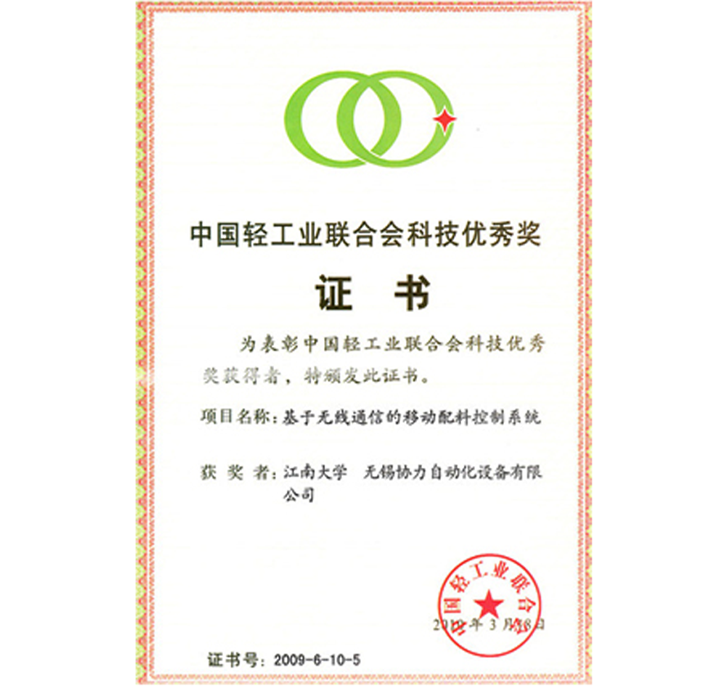
China National Light Industry Federation Science and Technology Excellence Award
Release time:
2023-03-09
2009 Science and Technology Excellence Award of the China National Light Industry Council Project: Mobile Batching Control System Based on Wireless Communication Awarded Organizations: Jiangnan University and Wuxi Xielì Automation Equipment Co., Ltd.
2009 Science and Technology Excellence Award of the China National Light Industry Council
Project: Mobile Batching Control System Based on Wireless Communication
Award-winning Organizations: Jiangnan University and Wuxi Xielì Automation Equipment Co., Ltd.
I. Project Overview
Scientific and technological field to which the project belongs, technical content, technical and economic indicators, application and promotion, and performance benefits, among other aspects:
1 , involving the technical field
Scientific and technological field to which this project belongs For automation engineering, embedded computer hardware and software development, and computer control software.
2 1. Project Background
The key to refractory production lies in batching and mixing; the accuracy of material proportioning has a profound impact on product quality. Refractories typically involve a wide variety of raw materials, making it difficult for conventional batching systems—comprising several feeding units and a fixed hopper scale—to meet production requirements. Therefore, developing an automated batching system with a mobile batching configuration is an urgent need for the refractory industry. As early as 1997, research was initiated on the automated batching of magnesia-carbon bricks, yielding initial success. After nearly 11 years of intensive effort, we have successfully developed multiple batching systems for both refractories and friction materials. Through continuous refinement, the current solution is a computer-based distributed automatic batching control system utilizing wireless communication and mobile weighing carts. This system can handle up to 36 different types of materials, effectively controls dust generation during batching, overcomes challenges such as feed blockage and arching in the batching process, and delivers control accuracy and reliability that fully meet operational requirements, thereby providing an ideal solution for the automated batching of refractories and friction materials.
3 1. Project Content
This research project focuses on the batching process for refractory and friction materials and has developed a wireless communication–based mobile automated batching system.
The system primarily consists of one industrial control computer, two weighing and batching carts each equipped with three weighing controllers, and a feeding device. The weighing controllers and the industrial control computer exchange data via ZigBee wireless communication modules, while the batching carts autonomously shuttle back and forth beneath 36 material bins to pick up and measure materials, thereby completing automated batching.
The system’s performance metrics are:
(1) Batching Truck
oh Bulk Hopper Scale: Net Capacity
oh Measurement range
oh Measurement range
Material delivery cart travel speed: 5~
Batching cart discharge rate:
(2) System efficiency metrics:
When the formulation requires automatic batching of a total of 15 materials, the total batching time is ≤18 minutes, with an actual measured value of 17 minutes.
4、 Application Promotion Status
The development and widespread adoption of a “wireless-communication-based mobile batching control system” can significantly enhance the level of batching automation in China’s refractory and friction-material industries. Implementation of this system markedly reduces workers’ physical workload, improves batching accuracy, and boosts product competitiveness.
III. Key Technological Innovations
Many overseas manufacturers have developed automated batching systems tailored for industries such as coking, metallurgy, cement, fertilizer production, plastics, and chemical processing. However, the refractory and friction-materials industries exhibit numerous characteristics that set them apart from other sectors: their formulations typically incorporate more than ten different raw materials with widely varying properties. In particular, friction materials can be adhesive, airborne, fibrous, or granular. Consequently, both domestically and internationally, dedicated batching-control systems for refractories remain relatively rare, while fully automated batching-control systems for friction materials are virtually nonexistent. In response, we have developed a wireless-communication–based mobile automated batching system suitable for both refractories and friction materials, and we have also pioneered China’s first truly fully automated batching-control system for friction materials. These innovations provide an ideal solution for the automated batching of refractories and friction materials.
This project was evaluated and approved by the Ministry of Education in December 2008, with the evaluation committee’s experts unanimously concluding that the project’s achievements have reached a domestically leading level. The project features the following key innovations:
1 , Independently researched and developed the hardware and software for the weighing controller.
The weighing controller independently developed under this project features high weighing accuracy, minimal temperature drift, and strong immunity to electromagnetic interference in industrial environments. In addition to accurately measuring weight and controlling the movement of batching vehicles, it also supports wireless remote transmission of weight and control data.
The weighing controller is based on AT.
2 , Two batching vehicles are equipped with collision-avoidance functionality.
When two batching carts operate simultaneously, there is a potential for collision. However, since both carts are equipped with anti-collision sensors, the entire batching control system can automatically detect such situations and command the carts to stop or yield, thereby enabling simultaneous batching by the two carts. This not only ensures high accuracy but also enhances production efficiency, delivering satisfactory results.
Crash handling is primarily carried out in two parts:
(1) Automatic collision avoidance in the host computer software. Specifically, the computer determines the target and current positions of both vehicles; when their target positions conflict, the vehicle that started later waits for the vehicle that started earlier to complete its current bin-handling operation and move away from the conflicting position before proceeding with its own bin-handling task.
(2) In extremely rare cases, if the control commands from the host computer are not properly transmitted to the slave units, there is a risk of collision between the two trolleys. To prevent such incidents, each trolley is equipped with an infrared transmitting and receiving module. When the distance between the two trolleys falls within the warning range, the infrared module detecting the close proximity sends an alarm signal to the control instrument, which then commands the trolley to stop. If both trolleys come to a halt and become mutually locked in this state, manual intervention by the operator is required: the operator can select the batching trolley that is farther from the target bin, manually reverse it until the other trolley reaches the target bin and the batching process begins, thereby releasing the mutual lock and allowing normal batching operations to resume.
3 , solved the dust-control issue during the batching process
The production environments for refractory and friction materials are characterized by high dust levels and harsh operating conditions, which can lead to a high failure rate of automated control systems. Through extensive experimentation over an extended period, this project has addressed the dust-control challenge by deploying onboard automatic ash-cleaning and dust-removal equipment along with automatically controlled sealed telescopic interfaces. These solutions ensure a hermetically sealed connection at the feed inlet, effectively preventing dust from escaping and thereby maintaining an optimal operating environment for the control system.
(1) On-board dust collector
The dust collector used in this batching vehicle is a baghouse. It is suitable for capturing fine, dry, non-fibrous dust. The filter bags are made of either woven filter cloth or non-woven felt, and rely on the filtration action of the fibrous fabric to filter dusty gas. When dusty gas enters the baghouse, larger and heavier dust particles settle out under gravity and fall into the ash hopper, while the gas containing finer dust is filtered as it passes through the filter media, with the dust being retained and the gas thereby purified.
(2) Dust-proof telescopic interface
To mitigate dust pollution, both the feed inlet and discharge outlet of the batching vehicle are equipped with sealed, telescopic connectors. During feeding or discharging, these connectors can form a tight seal with the discharge opening of the storage bin or the feed inlet of the material hopper.
The telescopic interface is fitted with a sealing sponge and can move vertically under the actuation of a pneumatic cylinder. One end of the dust cover is clamped onto the telescopic interface, while the other end is secured to the scale frame via screws. The rod of the telescopic cylinder is fixed to the lifting frame, and the cylinder body is mounted on a stationary support. The cylinder is controlled by a solenoid valve. When a feeding signal is received, the solenoid valve coil is energized, causing the cylinder rod to extend and drive the lifting frame upward, thereby raising the telescopic interface to press against the discharge nozzle plate of the screw feeder or belt feeder, enabling normal material feeding. Once the feeding process is complete, the solenoid valve coil is de-energized, and the cylinder rod retracts, lowering the lifting frame.
The lower telescopic interface is coordinated with the flap discharge device, allowing the interface to move vertically. The upper portion is connected to the flap discharge valve via a dust-proof boot, while the lower portion is fitted with a sealing sponge to ensure a tight seal with the discharge port. The tail end of the cylinder is fixed to the body of the flap discharge valve, and the cylinder rod is secured to the telescopic interface with bolts. The cylinder is controlled by a solenoid valve: when a discharge signal is received, the solenoid coil is energized, causing the cylinder rod to extend and drive the telescopic interface downward, pressing against the discharge-port cover plate to enable normal discharge. Once the discharge process is complete, the solenoid coil is de-energized, and the cylinder rod retracts, lifting the telescopic interface back to its original position.
4 The industrial PC, via the Hengstler I7000 control module, controls the variable-frequency drive to enable two-speed feeding—fast and slow—for all batching units, thereby ensuring batching accuracy.
Mobile batching systems typically face significant limitations in batching efficiency. To maximize efficiency while maintaining batching accuracy, we have implemented a variable-frequency drive to enable the feeding mechanism to operate at two speed settings—fast and slow—thereby ensuring both high accuracy and optimal throughput. In addition, through extensive experimentation, we have continuously refined and optimized the control software.
5 Implementation of Wireless Communication Between the Host and Slave Devices
By leveraging the emerging ZigBee wireless networking technology, wireless signal transmission is achieved, thereby eliminating the numerous drawbacks associated with wired data transmission in mobile robots.
This system requires one industrial PC and six weighing controllers to form the control system. If wired communication were used, the weighing cart would drag a cable during movement, leading to numerous drawbacks. Based on extensive field testing across multiple projects, we have adopted the emerging ZigBee wireless networking technology, which operates in unlicensed frequency bands, offers low latency, features robust self-organizing and self-healing capabilities, and delivers high communication reliability—thereby eliminating the disadvantages associated with wired communication.
Wireless communication is implemented using a ZigBee wireless communication module, which is an enhanced version of the standard ZigBee module. It integrates a RF transceiver and a microprocessor that comply with the ZigBee protocol standards, offering advantages such as long communication range, strong anti-interference capability, and flexible network configuration. The module supports transparent data transmission between devices in both point-to-multipoint and multipoint-to-multipoint topologies and can form both star and mesh network architectures. It features self-organization and self-healing capabilities: without manual intervention, network nodes can detect the presence of other nodes, establish connectivity, and form a structured network. Whether a node is added or removed, its position changes, or a node fails, the network can automatically recover and adjust its topology accordingly, ensuring continuous system operation. Additionally, the communication latency is low, enabling real-time communication.
This system implements real-time wireless communication between the host and slave devices via a one-to-many broadcasting scheme.
This project has undergone more than a decade of research, development, and continuous improvement, resulting in increasingly sophisticated technology. Long-term use by numerous customers has demonstrated the system’s stable operation and high reliability, with cumulative economic benefits exceeding RMB 100 million. It represents an ideal batching solution for the refractory and friction materials industries and holds significant potential for widespread adoption.
In the future, we will further refine this system and strive to extend its application to other similar enterprises, thereby generating greater socio-economic benefits.
XieLi Automation
Recommended
Contact Us

View mobile version
Copyright © 2024 Wuxi Xieli Automation Equipment Co., Ltd